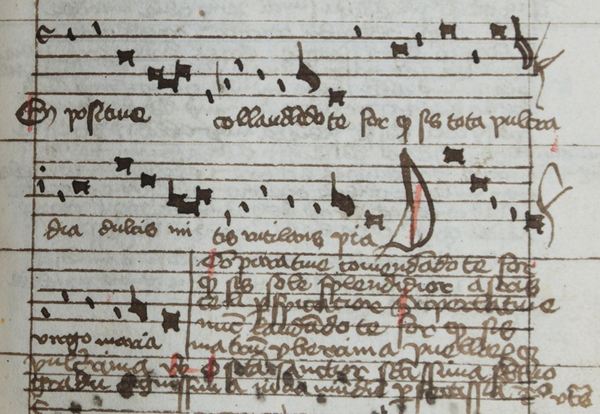
The journal Plainsong & Medieval Music, 34, 1 (2025), 73-96, just published the study A young teacher’s music in midfifteenth-century Bohemia: the peculiar case of Crux de Telcz (1434-1504); this is an expanded version of my Czech chapter in the three-volume publication Středověké knihovny augustiniánských kanonií v Třeboni a Borovanech [Medieval Libraries of Augustinian Canonries in Třeboň and Borovany], which was awarded the Bedřich Hrozný Prize in 2022.
We know mostly very little about collectors of medieval sacred and secular songs. How, then, does a collection look like whose compiler has a fairly detailed curriculum and whose educational and theological background is known? This is the case with Kříž of Telč, who collected sacred and secular songs known in the Central European area at the beginning of the second half of the 15th century. He did so in a presumably isolated Utraquist Bohemia. Recent refinement of his biography has shown that the songs were not collected by a somewhat eccentric Augustinian canon at the end of his life, but rather by a young teacher for the needs of his work at the lower Utraquist or Catholic schools. What was his point of interest in collecting songs and what kind of other books did he use?
