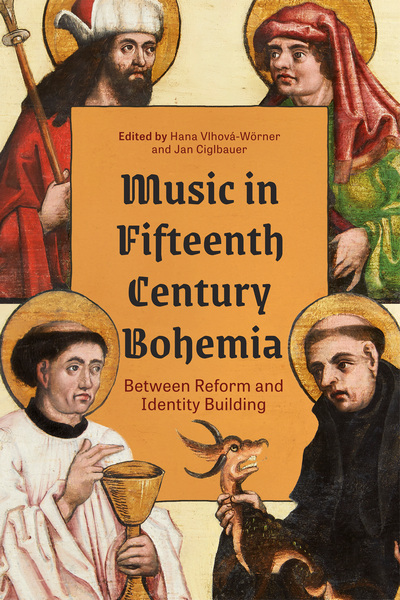
The University of Rochester Press / Boydell & Brewer has just published a collective monograph entitled Music in Fifteenth-Century Bohemia: Between Reform and Identity Building, edited by Hana Vlhová-Wörner and Jan Ciglbauer, as vol. 206 in its Eastman Studies in Music series.
The monograph covers the most significant phenomena in the musical tradition of the Czech lands in the 15th century and touches on the transformation of their interpretation by Czech and foreign historiography. The individual chapters provide insight into topics that were ignored or purposefully interpreted in 20th-century musicological research. Hussite and Utraquist culture, for example, revered and further developed the traditional liturgical forms and genres of Western church, as evidenced by the chapters devoted to sequences and songs intended to honor the memory of Jan Hus. Two other chapters focus on the development of Czech as a liturgical language and the use of songs in the practice of public and private piety. Here, a surprising partial return to Latin practice and the phenomenon of traditionalism in the Utraquist Church in the second half of the 15th century became apparent. The chapter devoted to polyphonic music in Czech sources, on the other hand, rehabilitates the reign of Vladislaus II Jagiellon and shows that even in relatively modest economic conditions, there was an early reflection of Franco-Flemish polyphony and contacts with the leading centers of this musical style. The myth of an isolated Hussite Bohemia is in many respects unfounded and not universally valid. The book concludes with a chapter on the reflection of Hussitism in the environment of the early national revival, which took place mostly without general knowledge of authentic sources from the early 15th century.
My chapter reflects on the changing function of sacred songs with Latin and vernacular texts in the Czech and Central European tradition in the period c. 1350-1520 and the treatment of this topic in German and Czech hymnology. The chapter focuses on hypotheses formulated in accordance with the nationalistic and confessional narratives of the 19th-20th century: German Protestant hymnology is rooted in the idea that the equal use of songs in the function of the Mass proper is a matter of the Reformation, and that the contribution of the Czech tradition is largely marginal. Czech hymnology, on the other hand, was preoccupied with presenting Czech song culture as a unique phenomenon linked to the Czech reform movement. However, a comparison of well-known and lesser-known sources shows that the process of introducing the song repertoire into the liturgy was gradual and largely non-confrontational throughout Central Europe, taking various forms long before the Reformation. However, songs with potentially heretical lyrics, secular songs with sacred lyrics, and the ars nova polyphony became problematic. The Czech lands were part of this process, and from the point of view of the liturgical function of songs, the pre-Hussite period in Bohemia can be characterized as an influential local acceleration of general trends in the period in question.
List of chapters
Sequences in Late Medieval Bohemia: Transformations in Genre, Form, and Function
Hana Vlhová-Wörner
Between Tradition and Heresy: Fifteenth-Century Liturgical Chants for Jan Hus
Rhianydd Hallas
Czech Liturgical Singing of the Later Fifteenth Century: Expression of Identity or Lost Local Tradition?
Eliška Baťová
Liturgy and Songs, ca. 1350–1520: On the Exclusiveness of the Bohemian Contribution
Jan Ciglbauer
Local Networks of New Polyphony in Bohemia, ca. 1470–1520: Sources, Repertory, and Performance Practice
Lenka Hlávková
Hussitism in Modern Czech Musical Culture: The Roots of Myths (1800–1848)
Viktor Velek
boydellandbrewer.com/book/music-in-fifteenth-century-bohemia-9781648251252/
